AI and digital transformation in Kazakhstan
AI solutions for real workflows
AI in Kazakhstan has moved past pilot projects. Government services run AI agents around the clock, transport systems use computer vision, and infrastructure investment is scaling compute capacity. For a business, the useful question is not whether to adopt AI. It is which task to hand over first.
- AI agents for support and internal operations
- Document and back-office automation
- Cloud infrastructure for AI workloads
We start with the task that repeats, measure what it costs today, and only then decide what to build.
Start with a task, not a technology
The projects that work begin with a specific, repetitive job. Answering the same five customer questions. Reading incoming invoices and entering the totals. Sorting support tickets by urgency. We measure how long that task takes now, how often it is done, and what a mistake costs. If those numbers do not justify the build, we say so. AI applied to a task nobody needed done is just an expensive experiment.
What we measure before writing code
- Time the task takes today
- How often it repeats each week
- What an error costs the business
- Who checks the result today
AI agents for support and internal operations
Escalation stays with your team
An AI agent is a system that takes an input, decides what to do, and acts, within limits you set. The clearest regional example is the 24/7 AI tax assistant available in Kazakhstan, part of a wider set of more than 50 AI agents handling citizen and business support. The pattern transfers directly to private companies: the agent handles routine, rules-based questions at any hour, and escalates anything unusual to a person. Your staff stop repeating themselves and start handling the cases that need judgment.
The design work sits in the boundaries. We write down which questions the agent answers on its own, which ones it drafts for a human to approve, and which ones it hands over immediately. Those rules are reviewed with your support lead, not decided inside the code.
Three handover points we define first
- Who reviews the agent output A named role on your side, with a queue that shows what the agent produced and what it changed.
- What happens when it is unsure Low-confidence cases route to a person instead of guessing, and the reason is logged for review.
- Where a customer asks for a human A single step out of the automated flow, into the channel your team already watches.

Automation of documents and back-office work
A large share of office time goes to moving information between formats. We build systems that read documents, extract the fields you need, validate them against your rules, and push them into your existing software. Invoices, applications, contracts, delivery notes. The human role shifts to checking exceptions. This kind of automation is unglamorous and usually delivers the fastest return, because the process is already defined and the volume is predictable.
How one document pipeline runs
Read the file
Extract the fields you named
Check them against your rules
Write into your existing system
Anything that fails a rule lands in a review queue with the original file attached, so the person checking it sees the same thing the system saw.
Computer vision in the field
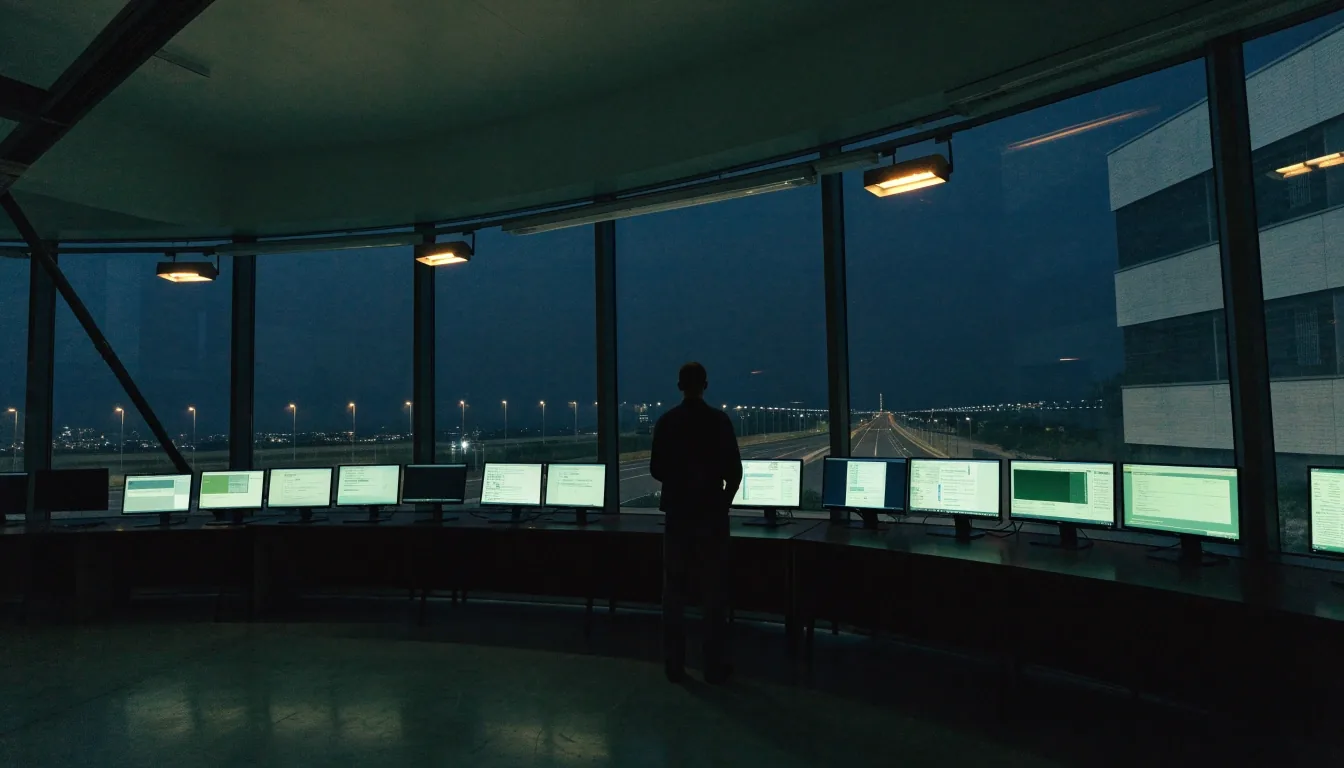
Kazakhstan's National Video Control System applies computer vision to transport, where the government has described using AI to analyze traffic, predict risks, and help prevent accidents. Similar techniques fit industry: checking product quality on a line, reading license plates at a warehouse gate, detecting safety violations from camera feeds.
Computer vision and monitoring
Computer vision reads images and video rather than text. These projects need clean camera input and a clear definition of what counts as an event. We scope both before writing code, because a camera that is angled wrong or a definition that drifts mid-project costs more to fix than to plan.
In practice that means a short site review: where the cameras sit, what lighting they work under, and which events your team actually needs to hear about. Most false alarms come from an unclear event definition, not from the model.
Product quality on a line
Cameras check each unit against the defects you already reject by hand, and flag the frame for a person to confirm.
Vehicle plates at a gate
Entry and exit are recorded automatically, with unmatched reads sent to the gate staff instead of blocking the queue.
Safety checks from camera feeds
Existing cameras are reused where possible, and alerts are limited to the zones your safety lead names.
AI for public-sector and regulated environments
Work with government bodies or regulated industries adds requirements: data residency, audit trails, access control, and explainability. We build with those constraints from the start, since retrofitting them is painful. The state's own programs set the expectation that AI systems in public use are documented and accountable. We apply the same standard to private-sector projects handling sensitive data.
Requirements we plan for from day one
- Where the data is stored and processed
- Who can see which records
- What each automated decision leaves behind
- How a decision is explained on request
Cloud infrastructure for AI workloads
AI features have infrastructure needs that ordinary web apps do not: GPU capacity for training or heavy inference, storage for large datasets, and enough bandwidth to move data without delays.

Kazakhstan is expanding this capacity directly. The Data Center Valley project announced in Ekibastuz is planned at 250 MW initially and expandable to 1 GW, and a 2026 memorandum with Citi and Freedom Holding Corp. targets a large-scale AI cluster with advanced GPU technology and a data center serving public-sector, research, and business needs. For clients, this means more realistic local options than a few years ago. We help you decide what runs locally and what runs elsewhere.
Deciding what runs where
Local hosting
Fits records that must stay in the country, and steady workloads where latency to a distant region matters.
Hosted elsewhere
Fits burst training runs and experiments where capacity can scale up and back down on demand.
Integrating AI without replacing your team
The failure mode we see most is a company buying an AI tool and expecting the organization to change around it. The work is the reverse: keep your people in charge, give them automation for the routine portion, and design the handover points carefully.
Who reviews the agent's output? What happens when it is unsure? Where does the conversation go when a customer asks for a human? Answer those three questions and adoption usually follows. Teams accept a tool that takes the dull half of their job far faster than one that claims the whole thing.
Where the national direction is heading
Kazakhstan has framed physical AI, connecting robotics, autonomous systems, and industrial automation, as a national direction tied to energy, transport, and manufacturing. AlemAI, the national platform, is discussed as a product with export potential. These programs are large, but they signal where skills and standards are going. Businesses that build clean data pipelines now will find industrial AI projects easier to start when the hardware and partners are ready.
The practical takeaway for a business today is narrower than the headlines: keep records in a shape software can read, and keep one person accountable for the quality of that data. That groundwork is what makes the next project cheap instead of painful.
What a first AI project looks like
A typical engagement runs six to twelve weeks. Two weeks to define the task and check feasibility. Four to eight weeks to build, test against real inputs, and tune. Then a monitored pilot with a small group before wider rollout. You get the evaluation criteria in writing: what accuracy looks like, what happens on failure, and how the system improves over time. No vague promises about intelligence, just a defined task and a way to check it is done.
See how we workHow the weeks are spent
- Two weeks · Define the task We map the current process, count the volume, and check whether the data needed to train or ground the system exists.
- Four to eight weeks · Build and tune The system is tested against real inputs from your business, not sample data, and tuned where it fails.
- Monitored pilot · Small group first A limited rollout with review of every automated action, before the process is handed over more widely.
You get the evaluation criteria in writing before the pilot starts, so the result can be checked against something agreed in advance.
Questions we hear before a first AI project
Do we need our own GPUs to start? Open
Most first projects do not. A task with clear rules and a moderate volume can run on hosted capacity, and you move to dedicated GPU infrastructure only when the workload or the data rules require it. We compare both routes during the feasibility stage and show what each one costs to run.
What if the system gets something wrong? Closed
That is why the handover points matter. Cases the system is unsure about go to a person instead of being answered automatically, and each automated action is recorded so a mistake can be traced back to the input that caused it. We agree on the review queue before launch, not after.
Can this connect to the software we already use? Closed
In most cases, yes. Document automation and agent workflows are built to push results into the systems you already run, through their existing interfaces or an integration layer. Where a system has no usable interface, we say so during scoping rather than discovering it mid-build.
How do we know it is actually working? Closed
Against the evaluation criteria agreed before the pilot: what counts as a correct result, what happens on failure, and how often a person had to step in. If the numbers do not hold during the monitored pilot, we tune it or stop before it reaches the wider team.
Next step
Bring us the task that keeps repeating
Tell us which job your team repeats most often and what it costs you today. We will come back with a plain answer on whether it is worth automating, what the first version would cover, and what it would need from your side. If it is not worth building, we will say that too.
Working hours
Monday to Friday, 9:00 AM – 6:00 PM
Requests sent outside these hours are read the next working morning.
Where we work
Furmanov Ave 110, 050000 Almaty, Kazakhstan
Projects run with teams in Kazakhstan and across the region.